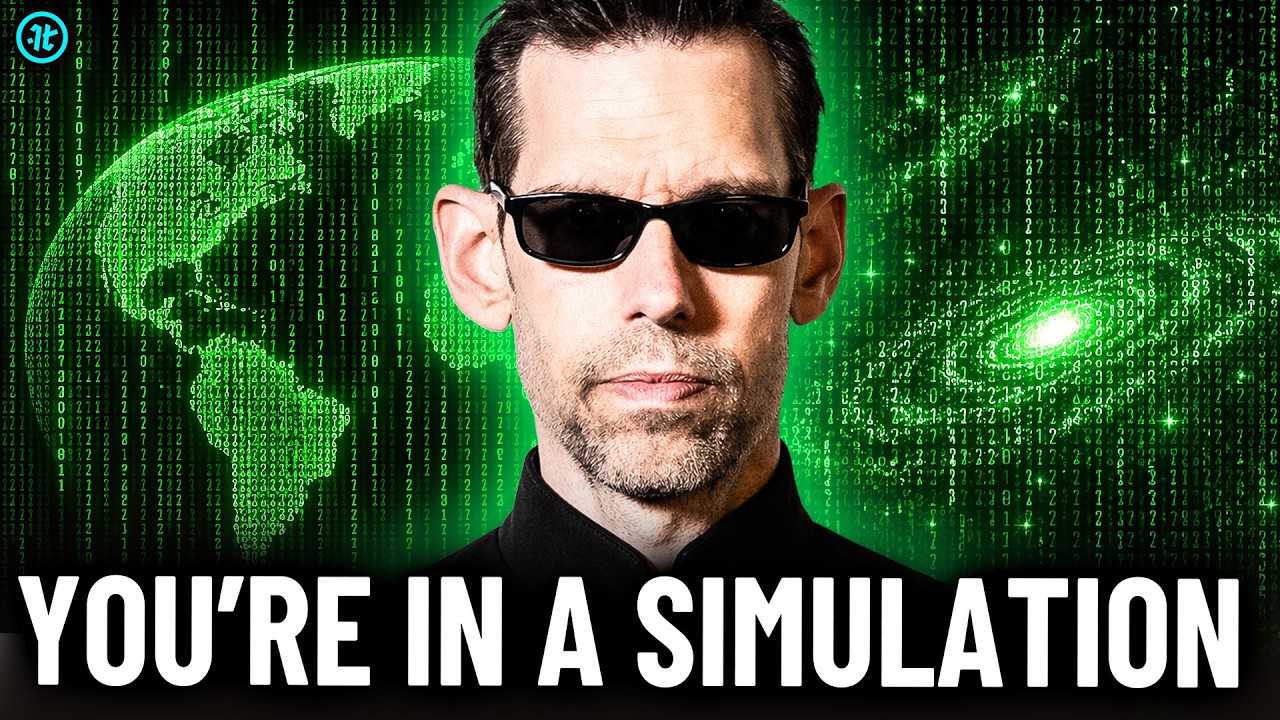
- The groundbreaking implications of recent research questioning the nature of the universe.
- The connections between scientific discovery and philosophical inquiry.
- How this research impacts our understanding of reality and perception.
- The role of skepticism in advancing scientific knowledge.
- The relationship between scientific advancements and societal beliefs.
A recent Nobel Prize was awarded to a group of researchers who proposed that the universe, as we know it, might not be real. This groundbreaking conclusion has sent shockwaves through both the scientific community and broader society. These scientists, through their rigorous examination of data and models, have challenged conventional wisdom, igniting discussions on what we perceive as reality.
Understanding the implications of this research requires exploring not just the findings but also the questions they raise. The idea that the universe might be an illusion has roots in philosophical thought, drawing parallels with ancient skepticism about the nature of existence. Philosophers have long debated the difference between perception and reality, and the researchers’ conclusions intersect with these discussions, promoting a reevaluation of both scientific methods and the nature of beliefs.
This new perspective has the potential to reshape our understanding of physical laws. If the universe is indeed not what it seems, the principles we rely on to define motion, energy, and matter may need to be reexamined. The implications extend far beyond theoretical physics; they impact various scientific disciplines, including biology and psychology. For instance, how we define life and its processes could be affected if the foundational reality of our universe is called into question.
The potency of skepticism cannot be overstated in science. Healthy doubt leads to rigorous inquiry, prompting researchers to question established norms. This skepticism has played a pivotal role in scientific advancements over centuries. From Copernicus challenging the geocentric model to Darwin’s theory of evolution, questioning established paradigms has led to monumental progress. This recent Nobel-winning work exemplifies that same spirit, emphasizing the necessity of probing deeper into subjects that might seem settled.
The societal implications are equally considerable. As people engage with the idea that reality may be subjective or illusory, it could instigate a philosophical shift in how individuals perceive their place in the universe. Beliefs about existence and consciousness may be transformed, encouraging broader discussions about spirituality and science. Such dialogues may help bridge gaps between secular and spiritual worldviews.
Exploring the connections between this research and established scientific principles reveals a rich tapestry of understanding. The inquiry into the fabric of reality necessitates reevaluating scientific frameworks. The exploration of quantum mechanics, for example, already suggests phenomena that defy traditional notions of reality. This newly awarded Nobel Prize may validate these concepts further, adding weight to arguments that the universe operates on a level beyond human perception.
Data analysis and mathematical modeling played crucial roles in the researchers’ work. Although this research leans heavily on theoretical physics, its conclusions require the meticulous gathering and interpretation of data. In scientific practice, the accuracy of results hinges on rigorous methodologies, something that this Nobel-winning research implemented. These methods contribute to the credibility of the findings, essential for widespread acceptance.
In this context, the dialogue between science and culture emerges as paramount. Scientific breakthroughs seldom occur in isolation; they often reflect and influence societal beliefs. Addressing this new perspective on existence invites a broader cultural engagement with science. Citizens may be more inclined to explore scientific literature and participate in discourse when faced with such intriguing propositions. This invites collaboration among scientists, educators, and public intellectuals, fostering a climate of curiosity and critical thought.
As individuals grapple with the implications of a non-material universe, the conversations that ensue may offer fresh insights into the fundamental questions of existence. How do we know what we know? What role does perception play in our understanding of reality? These inquiries enrich our comprehension of human consciousness and experience, helping us develop more sophisticated narratives surrounding existence.
Building a bridge between complex scientific concepts and lay understanding is essential. Thus, effective communication becomes a key to public engagement. Researchers and science communicators must prioritize accessibility, ensuring that the implications of such groundbreaking work reach a wide audience. Tools such as webinars, public lectures, and interactive online platforms can facilitate these discussions, empowering individuals to explore their inquiries further.
This Nobel Prize-winning research also highlights an important lesson for aspiring scientists and students. It demonstrates that success stems from questioning established norms and daring to venture into uncharted territories. The combination of creativity and analytical rigor often leads to unforeseen innovations. This philosophy can serve as inspiration across various fields, encouraging a more inquisitive mindset.
Navigating these turbulent waters of scientific inquiry necessitates embracing ambiguity. While the idea that the universe may be an illusion challenges fundamental beliefs, it may also create opportunities for growth. It pushes boundaries, urging individuals to embrace the unknown and seek knowledge in areas previously unexamined.
The journey to unpacking such profound themes is just beginning. As society acclimatizes to the ramifications of the notion that our universe may not be real, ongoing dialogue will be critical. Collaborations among scientists, philosophers, and the public will be vital to decode complex theories and explore their implications fully.
Engagement in this new scientific landscape also prompts questions about education. How should curricula evolve to incorporate the lessons drawn from this research? Examining the intersection of inquiry and skepticism will be crucial for nurturing young minds. By fostering critical thinking skills, educational institutions can help shape a generation prepared to navigate the challenges posed by profound scientific developments.
The implications of this recent research are monumental, echoing throughout disciplines far beyond physics. As parents, teachers, and mentors discuss the challenges of understanding existence, emphasizing critical thinking will become increasingly important. Students equipped with these skills will not only analyze scientific claims but also cultivate a sense of wonder about the universe—real or not.
As debates persist regarding this novel understanding, interdisciplinary approaches may reveal enlightening insights. Economists, sociologists, and psychologists can contribute significantly to the discourse around the philosophical implications of a potentially illusory universe. Understanding human behavior amidst such revelations can help structure societal responses to change.
Ultimately, this Nobel Prize signifies a critical point in scientific exploration. The drive to question reality, to delve deeper into the essence of being, can usher in new frontiers of knowledge. By fostering an environment where inquiry and skepticism are embraced, society can cultivate a richer understanding of both science and existence. The desire to understand the universe we inhabit, even when facing questions of its actuality, is a compelling journey that beckons all curious minds.
*****
Source Description
*Apologies! We had to repost this.*
AT&T Business: Switch to AT&T Business at https://business.att.com
Paleovalley: 30 for $36 https://paleovalley.com/offers/protein-sticks-36-72?utm_source=youtube&utm_medium=Bilyou
What if everything you see, feel, and experience isn’t the real world at all, but instead a meticulously rendered simulation?
In this episode of Impact Theory with Tom Bilyeu, we dive deep into one of the most mind-bending questions in science and philosophy: Are we living in a simulation? Join Tom as he breaks down the latest Nobel Prize-winning physics experiments that challenge our basic assumptions about reality itself.
From the quantum strangeness of the double-slit experiment to the mind-boggling implications of entangled particles, we explore why the universe may operate just like a video game—and what that means for everything you think you know. Get ready to have your understanding of existence turned upside down and discover why the odds that you’re living in “base reality” are vanishingly small.
00:00 – Intro
01:22 – Part 1: The Real World
07:10 – Part 2: The Experiments
19:36 – Part 3: The Nobel Prize
26:42 – Part 4: The Universe is Much Cooler Than You Think
Sign up for my AI Masterclass: https://tombilyeu.com/ai-masterclass
Check us out wherever you get your podcasts:
Spotify:https://open.spotify.com/show/1nARKz2vTIOb7gC9dusE4b?si=a8daffd2bf1f48fd
Apple: https://podcasts.apple.com/us/podcast/tom-bilyeus-impact-theory/id1191775648
Do you need my help?
STARTING a business: join me here inside ZERO TO FOUNDER (https://tombilyeu.com/zero-to-founder)
Get the exact systems, mindset shifts, and principles that built a $1B brand delivered straight to your inbox every week. Subscribe for free (https://tombilyeu.com)
Check out our Video game – Project Kyzen: (https://projectkyzen.io/)
Catch Me Streaming on Twitch – (https://twitch.tv/tombilyeu)
Link to IT discord: https://discord.gg/TZKJ2etPbT
Tom’s Favorite Things List: https://amzn.to/41Ftt7e
FOLLOW TOM:
Instagram: https://www.instagram.com/tombilyeu/
Tik Tok: https://www.tiktok.com/@tombilyeu?lang=en
Twitter: https://twitter.com/tombilyeu
YouTube: https://www.youtube.com/@TomBilyeu