*****
Summary of Transcript:
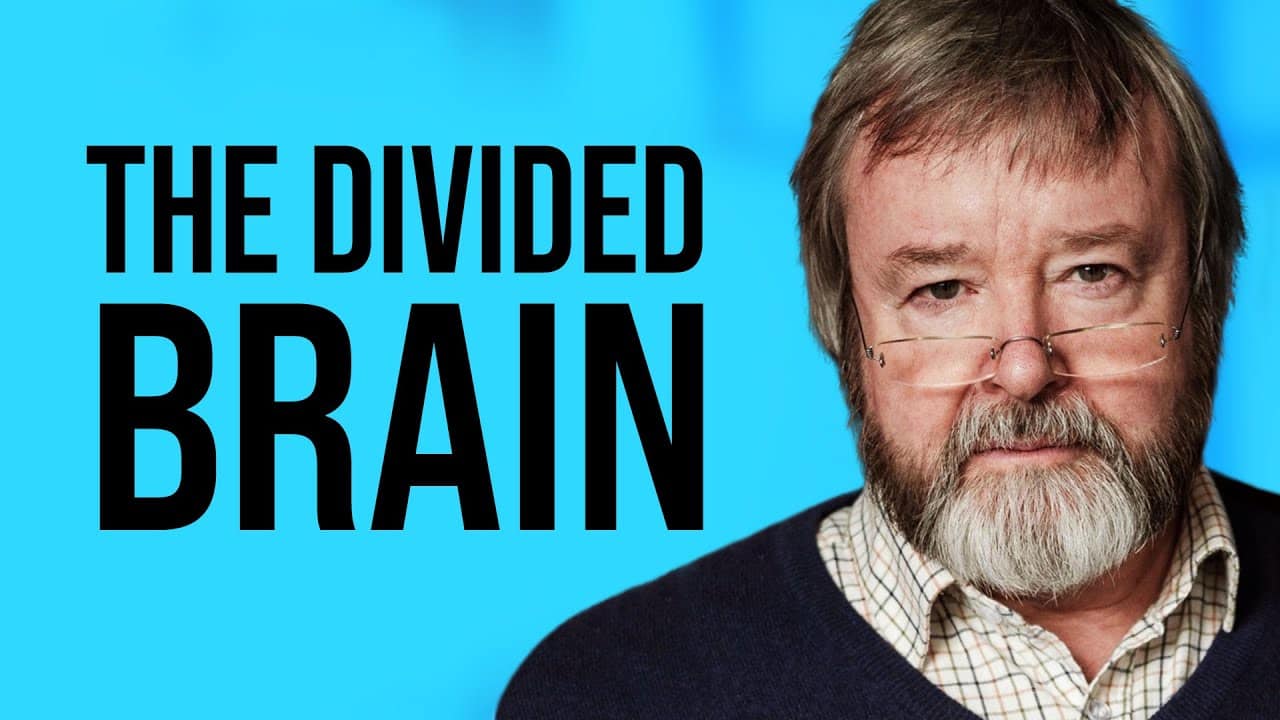
The video features an interview with Dr. Ian McGilchrist, author of “The Master and his Emissary.” The interviewer expresses his fascination with the brain and brain plasticity and how learning about the brain gave him hope in his early 20s. They discuss split-brain patients and how the corpus callosum controls electrical impulses during seizures. The interviewer asks Dr. McGilchrist to define a split-brain patient and the purpose of cutting the divide between the two halves of the brain. They also discuss the difference between the right and left hemispheres and the importance of understanding their distinct functions. Dr. McGilchrist’s work focuses on how the different hemispheres interpret the world and how this affects our perception of truth.
*****
Summary of Description:
Renowned psychiatrist Iain McGilchrist discusses the importance of being open-minded and aware that myths and stories influence our perceptions of reality. He explores the complexities of consciousness, matter, space, and time, highlighting the beauty and complexity of order in the universe, even in areas we don’t fully understand. McGilchrist calls for people to be open to the seemingly chaotic and meaningless aspects of life to find a better way to live and a better vision of the world, encouraging embracing paradoxical reactions occurring in nature. Ultimately, he suggests that to understand humans fully, we must start with the brain, respecting and exploring all four pathways to the truth: science, reason, intuition, and imagination.
*****
Renowned psychiatrist, author, and thinker Iain McGilchrist join Tom in a fascinating discussion about his latest two-volume book, The Matter of Things. According to McGilchrist, what we choose to see and live by is determined by the fact we see. In the book, he highlights that much of what we perceive as myths and stories shape our reality; thus, it is vital to keep an open mind.
During the conversation, McGilchrist calls for people to be open to life’s seeming randomness and chaos to lead a better existence and develop a better perception of our world. He points out that many paradoxical reactions occur daily, and being open to them is the path to finding a better way to live.
He explores the cognitive function of the left and right hemispheres of the brain, revealing how little we know about this aspect. He also talks about the beauty and complexity of order in the universe, even where we cannot understand it fully. McGilchrist quotes William James, “Ignorance is a sea, and knowledge is a drop in that ocean,” highlighting our limited understanding of the universe’s complexities.
McGilchrist highlights that neurology and theology are not enemies; both are focused on the same reality but from different perspectives and levels. He emphasizes the importance of respecting science, reason, intuition, and imagination, as they provide additional pathways to truth.
To better understand McGilchrist’s ideas, check out his book, The Matter With Things. The discussion is an eye-opener for people looking to broaden their knowledge of the world and live a better life.
*****
Source Description
I’m teaching a LIVE workshop later this November to teach you how to make ANY goal stick.
Look – the truth is, most people never come close to achieving their goals – and it’s not because they’re not smart enough or not worthy. It’s because they aren’t using the right strategies to stick to doing the work that will lead to their success. Achieving goals is a PROCESS – you can learn and improve at it. To join me and register your seat, go to live.impacttheory.com.
Iain McGilchrist, renowned psychiatrist, author, and thinker, joins Tom to share some of the key ideas he writes about in his latest 2 volume book, The Matter of Things. Part of what he proposes is that you keep an open mind and be aware that the ideas and images of our myths and stories strongly influence people. The version of what you see in reality matters to what you decide to visit and live by.
“It doesn’t matter what you look at; it matters what you see.” -Henry David Thoreau.
So much of the world and who we are is not understood. To think you fully grasp the complexities of consciousness, matter, space, and time would be wildly ignorant. Iain perfectly quotes psychologist William James, “Ignorance is a sea, and knowledge is a drop in that ocean” In this conversation, Iain explores how little we truly know about the cognitive function of the left and right hemispheres of the brain. He highlights the beauty and complexity of order in the universe, even where we cannot fully grasp and understand the order. He’s calling people to be open to the seemingly random chaos and meaninglessness of life to find a better way to live and a better vision of our world. The path of doing so challenges you to embrace the many paradoxical reactions occurring all around us in nature.
Check out Iain McGilchrist’s book, The Matter With Things: https://channelmcgilchrist.com/the-matter-with-things/
SHOW NOTES:
0:00 | Introduction Dr. Iain McGilchrist
2:10 | Split Brain Connection
8:50 | Unity of Opposite Hemispheres
22:08 | The Brain Shapes Reality
27:49 | Objective Reality & Co-Creation
35:10 | 3 Pathways to One Vision
44:16 | The Sacred and Divine
55:44 | Why Belief Matters
1:05:53 | Left-Sided Paradox
1:10:57 | Neutralizing Left-Sided Thinking
QUOTES:
“Everything that exists, not just in the brain, but in physics, in the world at large in nature, depends on a combination of division and union […] There needs to be the synthesis of union with division.” [8:59]
“Both hemispheres do everything in some way, but it’s all about that ‘in some way.’ It’s the how, not the what. So they do the ‘what’ of the same things but the how of them completely differently.” [12:47]
“The emotional brain is as much the left hemisphere as the right. It specializes in anger, irritability, and doesn’t like being crossed.” [28:43]
“Neurology and theology are not at war with one another; they are seeing the same realities just at slightly different levels and in different ways.” [35:42]
“If you want to know about a human being, the brain is a central place to start.” [39:32]
“I would be giving the wrong impression if I said that I know anything about what God is, or I’m a believer in whatever, but it will also be equally wrong to say, ‘I dismiss this, or I don’t believe it.'” [56:21]
“Belief is not about believing six impossible things before breakfast. It’s about a disposition of your mind towards the world.” [57:36]
“We need to be able to avoid this way of reducing our understanding, keeping ourselves open to all and wonder, keeping ourselves with a little humility about what our intellects can do, and having compassion for people who disagree with us.” [59:57]
“We should live in a world where there is virtually nothing you can’t say; it’s how you say it.” [1:11:56]
“There are four pathways to the truth, science, reason, intuition, and imagination. Any worldview that tries to get by without paying due respect to all four of these is bound to fail.” Iain McGilchrist read by Tom [1:16:48]
Follow Iain McGilchrist:
Website: https://channelmcgilchrist.com/
YouTube: https://www.youtube.com/channel/UCW0LCKUFTTtgitH33Mx6u-A
Twitter: https://twitter.com/dr_mcgilchrist
Facebook: https://www.facebook.com/DrIainMcGilchrist/
LinkedIn: https://www.linkedin.com/in/dr-iain-mcgilchrist-b931aa1a2/#


Comments are closed