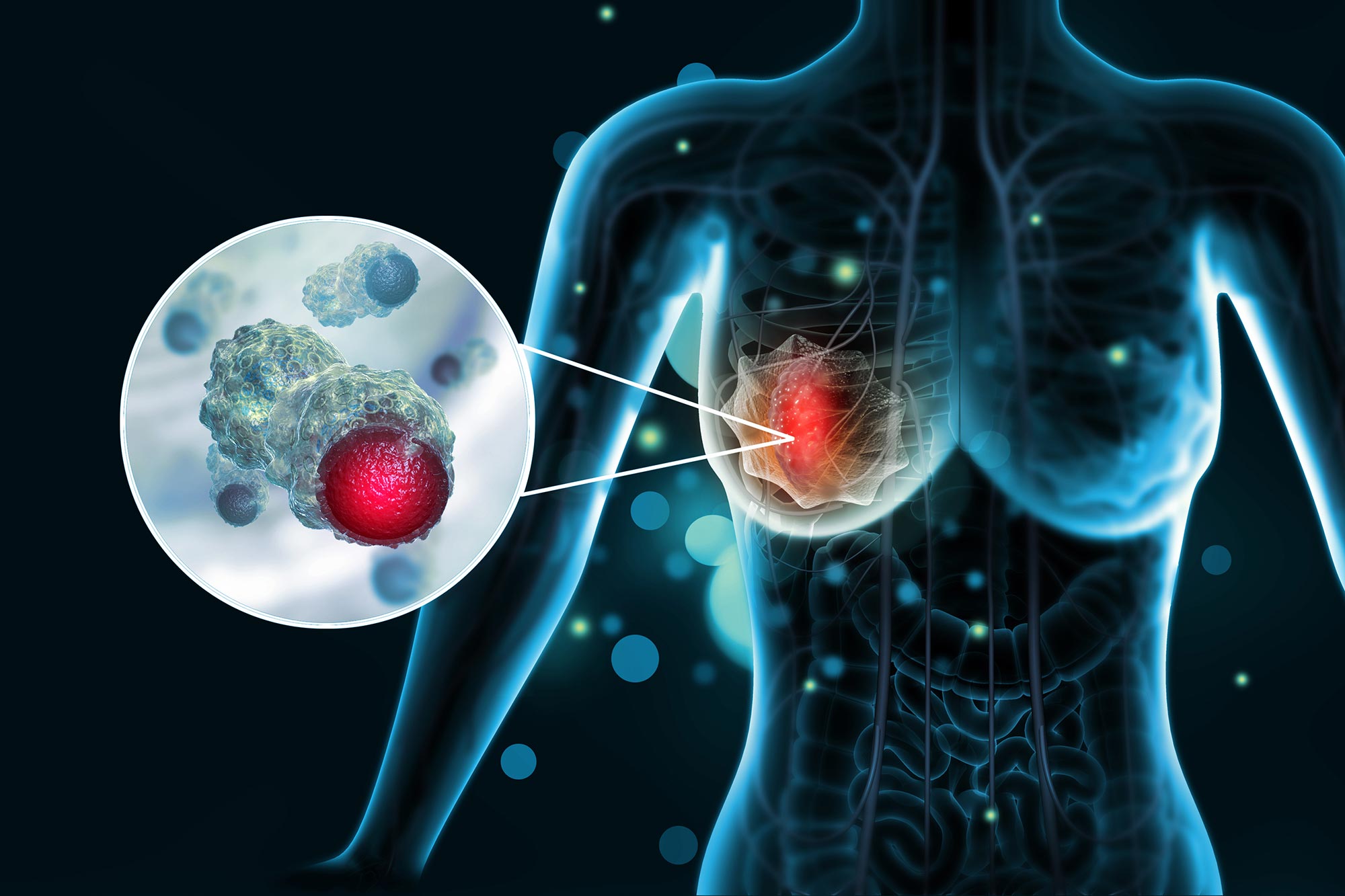
Summary of Scientists Discover Molecular “Switch” That Could Stop Breast Cancer From Spreading:
Researchers at Hiroshima University have identified a mechanism by which the vasoactive intestinal peptide receptor-2 (VIPR2), when overexpressed, contributes to breast cancer growth and metastasis. Normally involved in various bodily functions, including circadian rhythm and immune responses, VIPR2 can promote cancer progression by forming dimers—pairs of its molecules. The study found that the dimer formation enhances tumor growth and spread through specific receptor interactions.
By investigating how VIPR2 pairs up and functions, the researchers discovered that introducing small peptide chains called TM3-4 can prevent dimerization, resulting in reduced tumor growth and metastasis in cancer cells. They plan to explore the potential of the TM3-4 peptide as a new anticancer treatment targeting cells with high VIPR2 expression. The findings were published in the British Journal of Pharmacology.
*****
Summary of Key Points
- A breakthrough study at Hiroshima University has identified a molecular “switch” involving the receptor VIPR2 that can potentially halt breast cancer growth and metastasis.
- Normal physiological functions of VIPR2 include regulating circadian rhythms and immune responses, but overexpression can lead to tumor proliferation.
- The process of dimerization—where two VIPR2 molecules bond together—was found to facilitate breast cancer progression.
- Research indicates that a segment of protein, TM3-4, can disrupt this dimerization, offering a promising lead for new anti-cancer treatments.
- Ongoing studies aim to develop novel drugs targeting VIPR2, with potential benefits for patients facing aggressive forms of breast cancer.
Unpacking the Molecular Breakdown of Breast Cancer
In the ever-evolving landscape of medical research, breakthroughs that provide hope are always compelling. One recent study from Hiroshima University shines a light on the promising potential of understanding the molecular intricacies that underpin breast cancer. A team of researchers has identified a receptor known as vasoactive intestinal peptide receptor-2 (VIPR2) and its role in the proliferation and metastasis of breast cancer. The implications of this discovery extend far beyond basic science; they could offer avenues for innovative anticancer therapies.
The Role of VIPR2 in the Body
Before delving into its connection with cancer, let’s first appreciate the essential functions of VIPR2 in normal physiology. This receptor is fundamentally involved in various biological processes—influencing circadian rhythms, immune responses, and insulin release, among others. Imagine your body as a finely tuned machine; every part has its job, and VIPR2 is one of those components ensuring everything operates smoothly.
However, as with many elements in life, imbalance can lead to complications. When VIPR2 is overexpressed, it can lead to faster breast cancer cell growth. At high concentrations, this receptor can link to another VIPR2 molecule, forming a dimer—this seemingly minor change becomes a significant player in the drama of cancer growth and spread.
The Mechanism of Dimerization
Let’s dive deeper into the processes occurring with VIPR2. When two VIPR2 receptors dimerize, they can behave quite differently than they would as individual units. Researchers at Hiroshima University set out to uncover exactly how this dimerization drives breast cancer. By examining the means by which VIPR2 interacts with itself and the cellular implications of these interactions, they began outlining a pathway to potential treatments.
Combatting cancer often involves addressing how abnormal cells behave. VIPR2, in its dimerized form, behaves in a manner conducive to tumor growth. The research revealed that this interaction occurs at specific regions on the receptor known as transmembrane domains. If you think of these domains as connection points, they allow for either reinforcement or prevention of dimerization.
Introducing TM3-4: The Game Changer
Enter TM3-4—a segment of amino acids that can disrupt the interaction of VIPR2 molecules. In ongoing experiments, when breast cancer cells express TM3-4, the distance between VIPR2 receptors expands, and the formation of dimers is inhibited. Think of this as a disruptive force breaking up a two-part harmony that allows cancer to flourish.
In cellular experiments, the outcome was telling. Cells that expressed TM3-4 showed suppressed tumor growth and a marked decrease in lymph-node metastasis. This suggests that targeting this molecular switch could become a cornerstone of future treatments for aggressive breast cancer variants.
The Power of De-Dimerization
What does it mean to de-dimerize VIPR2? In simpler terms, breaking up these dimers means reducing the receptor’s affinity for specific proteins involved in promoting cell proliferation and metastasis. By inhibiting the interactions that lead to tumor growth, researchers are effectively taking away cancer’s tools for spreading.
The findings did not merely add to existing knowledge; they opened doors to research avenues that could lead to real-life treatments. As one of the lead researchers, Yukio Ago, points out, the ultimate goal is to test the anticancer effect of the purified TM3-4 peptide within animal models, paving the way for innovative drugs targeting cancer cells that rely on VIPR2 overexpression.
Bridging the Gap between Research and Clinical Application
But how does this entirely scientific discussion thrive outside laboratory walls and become applicable to patient care? This is where the conversation becomes actionable. The road from lab bench to bedside is long and filled with challenges, but many drivers are at work pushing this research forward.
Funding from prominent organizations such as the Japan Society for the Promotion of Science and the Japan Agency for Medical Research and Development has allowed researchers the freedom to explore these exciting new avenues. It’s a heartfelt reminder that science often thrives through collaboration and support.
Also, consider the implications for patient quality of life. While scientists hunt for molecules and pathways, the ultimate goal is a human one—improving life for those affected by cancer. Developing a treatment that effectively targets aggressive forms of breast cancer opens a spectrum of new possibilities for patients battling this challenging disease.
The Broader Implications
Each scientific discovery feeds into the larger narrative of understanding cancer as a multifaceted challenge. The investigations into VIPR2 and its role in breast cancer pave a pathway for potential therapies not just limited to breast cancer, but possibly applicable to cancers in varying forms and contexts. It holds the promise of personalized medicine that could transform treatment regimens, harnessing the power of molecular biology to tailor therapies for individuals based on their receptor profiles.
Consider this: as advancements are made, you might one day hear your doctor specify a treatment that not only eradicates cancer cells but strategically utilizes your body’s own mechanisms to fight back. The intersection of molecular biology and clinical oncology is a fertile ground for hope and innovation.
Staying Motivated Amidst Challenges
While the scientific community works tirelessly to uncover these truths, what does it mean for those of us on the sidelines? Life continuously presents us with obstacles, much like the complex battles fought by researchers and patients alike. Staying motivated is a universal endeavor.
-
Embrace Curiosity: Learning about breakthroughs like VIPR2 piques interest and encourages a mindset geared towards exploration. Just as scientists uncover hidden mechanisms, we can explore our horizons, asking why and how things happen.
-
Find Inspiration in Progress: Each small finding has the potential for ripple effects. Celebrate progress in both science and life—every small victory counts.
-
Support Each Other: Just as collaborations in research lead to breakthroughs, forming supportive networks in our personal lives can help spur growth and resilience.
- Stay Open to Change: In both science and our individual lives, staying versatile is essential. The ability to adapt and embrace new possibilities can yield unforeseen positive outcomes.
Conclusion: A Future to Look Forward To
The study at Hiroshima University is not merely a chapter in the field of oncology; it serves as a beacon of clever thinking, collaboration, and unyielding hope. As researchers explore the complexities of VIPR2, the resulting treatments can provide powerful tools against one of humanity’s toughest critics—cancer.
Approaching this discovery with enthusiasm could remind us that life, much like scientific discovery, is an intricate dance of exploration, uncertainty, and optimism. In the fight against breast cancer, understanding the molecular “switch” is but one step towards untangling a more extensive web of interconnected challenges and triumphs.
Health is a journey, blending knowledge and resilience. Stay informed, stay engaged, and let’s navigate the complexities of life and science together. Your awareness could just spark a whole new wave of change, one that may one day lead to breakthroughs we can hardly imagine today.