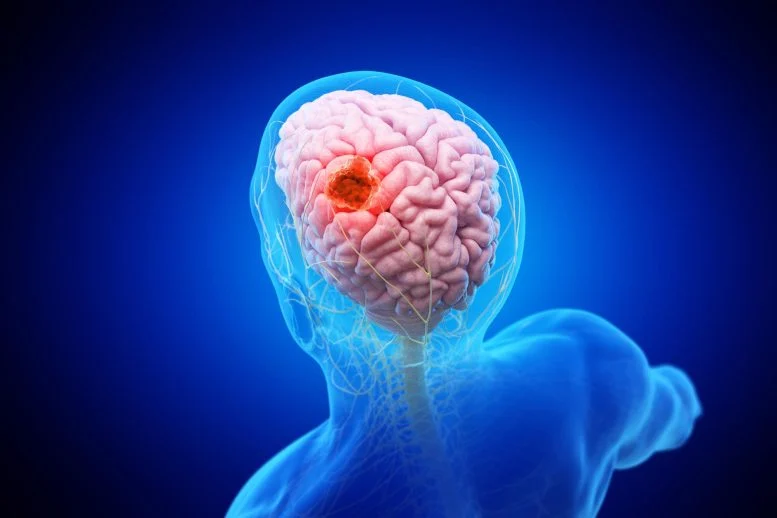
Summary of A “Double Punch” Nanoparticle Could Reveal and Destroy Brain Cancer Cells:
Researchers from the University of Technology Sydney (UTS), Harvard, and Henan universities have developed a novel ‘double punch’ nanozyme platform aimed at improving glioblastoma treatment, which is particularly challenging due to its invasive nature and the limitations of the blood-brain barrier. The platform consists of a two-dimensional material that serves dual functions: it aids in imaging tumors during surgery by glowing under near-infrared light, allowing for the visualization of tiny cancer cell clusters, and it provides targeted treatment post-surgery.
Once the visible tumor is removed, the nanoparticle can be reactivated with the same light to perform phototherapy, converting hydrogen peroxide produced by the tumor into oxygen and generating heat and reactive molecules to eliminate remaining cancer cells. In mouse models, this method significantly suppressed tumor recurrence and improved survival rates compared to surgery alone.
While the results are promising, the technology is still in early-stage research, requiring extensive testing in human models. If successful, this innovation could enhance the ability of surgeons to identify and treat glioblastoma more effectively, potentially reducing recurrence rates, a significant challenge for patients.
*****
Summary Bullet Points:
- Researchers have developed a groundbreaking ‘double punch’ nanoparticle designed to improve the surgical treatment of glioblastoma.
- This innovative approach utilizes a single, ultra-thin material for both imaging during surgery and targeted therapy afterward.
- The nanoparticle’s effectiveness lies in its ability to illuminate small tumor clusters and deliver phototherapy, potentially improving survival rates in mouse models.
- Current challenges involve transitioning this research from animal models to human clinical trials, emphasizing the need for further validation.
- The ultimate goal is to enhance surgical precision and reduce glioblastoma recurrence rates, providing hope for patients facing this aggressive cancer.
The Revolutionary "Double Punch" Nanoparticle: Illuminating the Path to Overcoming Glioblastoma
In the realm of medical breakthroughs, few topics capture attention like advancements in cancer research. Among the most formidable foes humans face is glioblastoma, the most aggressive form of primary brain cancer. Touted for its lethal speed and malignant infiltration, glioblastoma presents a daunting challenge to both patients and healthcare professionals alike. Current treatments often fall short, leading to a sobering five-year survival rate of merely 7 percent. Yet, every challenge opens the door for innovation, and recent advancements from a collaboration between the University of Technology Sydney, Harvard, and Henan universities bring a flicker of hope.
What if I told you that a nanoparticle, referred to as the "double punch" nanozyme, could fundamentally change how we tackle this cancer?
Understanding the Complexity of Glioblastoma
Before diving into the particulars of this nanoparticle, it’s vital to understand why glioblastoma poses such a complex challenge. Glioblastoma tumors are notorious for their heterogeneous and microscopic nature: they have the ability to spread tiny clusters of cancer cells deep into the healthy brain tissue, making complete removal during surgery incredibly difficult. Surgeons must balance the fine line of excising as much of the tumor as possible while preserving vital brain functions. In addition, the blood-brain barrier—a highly protective shield around the brain—often restricts the effectiveness of many drugs and treatments. Together, these hurdles form a nearly insurmountable wall against effective treatment.
With such formidable obstacles, is there a way to turn the tide?
Introducing the Innovative "Double Punch" Nanoparticle
Enter the hero of our story: the double punch nanozyme, engineered to illuminate and obliterate glioblastoma cells in a two-fold approach. As Dr. Bingyang Shi from the University of Technology Sydney describes, this groundbreaking material is designed to help surgeons navigate during surgery while also serving as a targeted therapy for the aftermath of the procedure.
Imagine a material with extraordinary properties: an incredibly thin, two-dimensional sheet made up of precisely positioned atoms. The technology harnesses methodologies borrowed from semiconductor manufacturing to assemble this remarkable material. But what makes this nanoparticle truly fascinating is its dual functionality.
Image-Guided Surgery: Finding the Invisible
During surgery, this nanoparticle acts as a highly sensitive imaging agent, with a fluorescent dye engineered onto it that glows when exposed to near-infrared light—light that is invisible to the naked eye. This allows surgeons to visualize microscopic tumor clusters as small as 44 micrometers, surpassing the capabilities of current clinical imaging methods.
Can you envision the implications? Surgeons armed with enhanced tools can pinpoint small clusters of lingering cancer cells that would otherwise be imperceptible. By effectively mapping the cancer landscape inside the brain, this innovation could radically change surgical outcomes, minimizing the risk of leaving cancerous cells behind to multiply.
A Targeted Clean-Up Crew
But that’s just the beginning. Following the visible tumor’s removal, the same nanoparticle can be administered into the surgical cavity—a true ‘two-for-one’ scenario. Once again activated by the same wavelength of light, it switches roles to become a targeted clean-up treatment.
Utilizing platinum atoms, the nanoparticle can convert the tumor’s own hydrogen peroxide into oxygen. This fate is crucial because glioblastoma cells often thrive in low-oxygen environments. Alongside this, light exposure generates heat and reactive molecules capable of vanquishing those sneaky microscopic cancer cells that managed to escape the surgeon’s grasp.
Research breakthroughs often lead to hopeful stories, and in mouse models of glioblastoma, this applied nanozyme treatment showed remarkable efficacy. Treated mice exhibited a significant increase in lifespan—surviving at least 60 days post-surgery compared to an average of 42 days for those receiving surgery alone. Furthermore, the follow-up indicated no neurological or motor deficits caused by the treatment.
The Hurdles Ahead: Transitioning to Human Trials
However, amid the excitement lies a critical understanding: while the results from animal studies are promising, they remain just that—preclinical. The leap from mouse models to human testing brings forth a unique set of challenges. Researchers must confirm whether their imaging and therapeutic capabilities can effectively scale to accommodate the complexities of a human brain.
Dr. Shi reminds us of the importance of this transition: "The results are very encouraging, but this is still early-stage research." Hence, the path forward involves rigorous testing, scrutinizing the nanoparticle’s efficacy while paving the way for clinical trials.
If the journey continues on this promising trajectory, there lies the incredible possibility that surgeons may one day possess enhanced abilities to visualize and treat glioblastoma. This leap could signify a meaningful stride toward reducing recurrence, one of the most formidable challenges in the battle against glioblastoma.
An Inspirational Takeaway
In contemplating the future of glioblastoma treatment, one can draw parallels to the struggles we all face in life. Challenges often seem insurmountable, much like the obstacles presented by this aggressive cancer. Yet, every daunting issue paves the way for innovation, creativity, and breakthrough solutions.
In life, as in science, resilience is key. With perseverance and collaboration, the scientific community strives to unlock the mysteries of disease, giving patients and their families renewed hope. Just as researchers work day and night to illuminate the challenges of glioblastoma, we too can illuminate our paths, confront our battles head-on, and never lose sight of our goals.
Imagine standing on the brink of possibility—just as patients and researchers envision a future where glioblastoma treatment has evolved into something manageable. What dream are you ready to chase, even if it feels far off? Allow the breakthroughs in science to inspire your journey toward overcoming obstacles, one step at a time.
The double punch nanoparticle may very well symbolize a future not only in medicine but in life as well—where innovation, hope, and resilience collaborate for a brighter tomorrow.
Moving Forward with Hope
Ultimately, while the double punch nanozyme captures the imagination and represents a beacon of hope in treating glioblastoma, it also serves as a reminder: persistence and ingenuity in the face of obstacles can yield incredible outcomes. As we look ahead to the ongoing research and potential clinical trials, let us embrace the spirit of innovation and resilience. After all, the future, much like the fight against cancer, is full of possibilities waiting to be explored.
We are in an age of discovery, and each breakthrough—big or small—reminds us of the unyielding human spirit. So tackle the challenges before you with courage, and know that every step toward innovation in science ultimately reflects our capacity to rise above adversity. Together, let’s champion a future where challenges are met with creativity, and give hope to those who need it most.