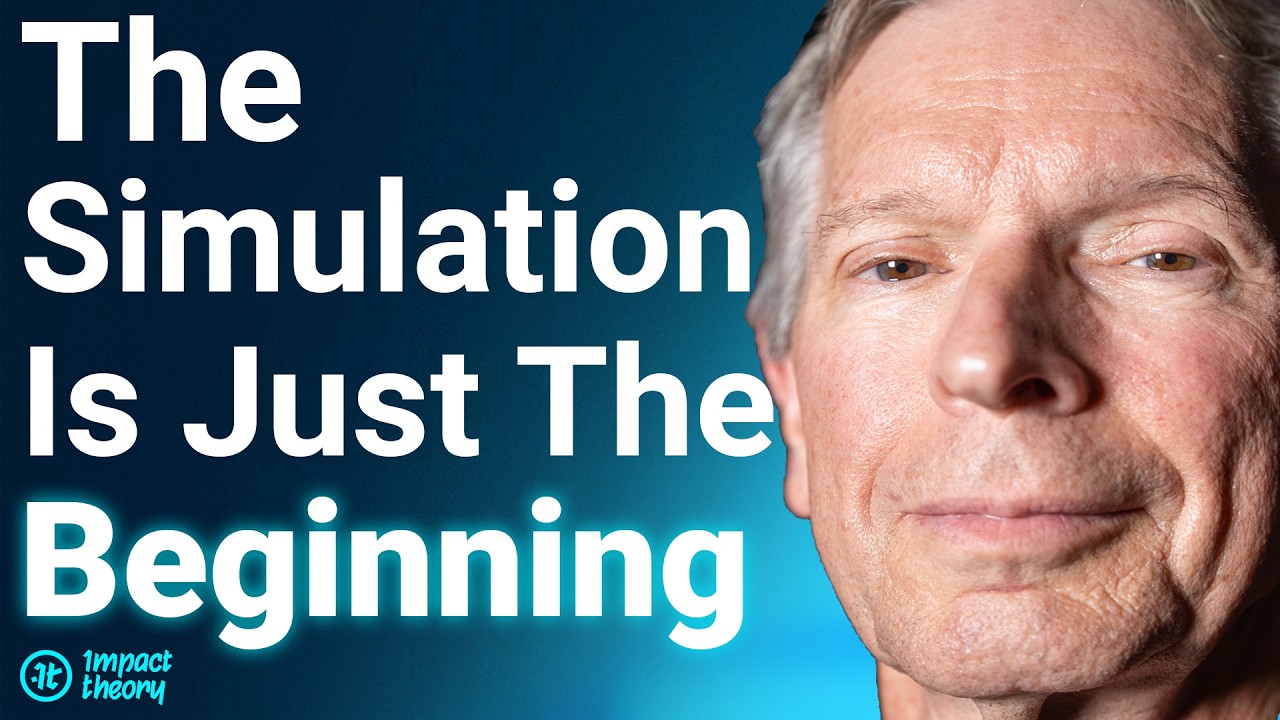
- The concept of simulation and perception in cognitive science
- Insights from Donald Hoffman’s work on reality perception
- Implications of simulation theory for understanding human experience
- The intersection of philosophy, science, and consciousness studies
- Practical applications of perception theory in everyday life
The discussion around the idea that we might be living in a simulation has intrigued philosophers, scientists, and thinkers for decades. Donald Hoffman is a cognitive scientist who has extensively explored this topic, suggesting that the way we perceive reality may not accurately reflect the true nature of existence. His theories challenge conventional views, prompting deeper reflections on human consciousness and perception.
Hoffman argues that human perception evolved not to provide an accurate representation of the world but rather to serve our survival needs. This perspective suggests that our sensory experiences are more like a user interface than a window into reality. They allow us to navigate the environment effectively, but they do not reveal the complexities of the underlying "truth." In essence, what we see and experience may be analogous to a computer desktop, where we use icons to access deeper functions without ever truly seeing the code that runs beneath.
This idea raises questions about the nature of reality and existence. If our perceptions are mere constructs serving a survival function, what does that mean for our understanding of consciousness? Hoffman’s work promotes a dialogue between cognitive science and philosophy, offering insights into how we interpret our surroundings. He suggests that rather than perceiving the world as it is, we are perceiving what is beneficial for us. This could mean that color, sound, and even physical forms may not exist as we perceive them; they could be nothing more than a convenient way for our brains to manage complex information.
Delving deeper into Hoffman’s theories, the implications extend to the broader landscape of cognitive science. His ideas challenge the idea that human consciousness operates in isolation. Instead, they imply a networked reality, suggesting interconnected experiences. This ties into modern thoughts about collective consciousness and shared realities, where individual perceptions may influence broader social constructs. Understanding how perception shapes our beliefs can lead to significant transformations in areas like education, where how we learn and process information could be redesigned to align with these insights.
The intersection of philosophy, science, and consciousness studies offers fertile ground for exploring these topics. Hoffman’s ideas resonate with various philosophical perspectives, particularly those that emphasize subjective experience. When considering topics like metabolic wellness, insights into perception can also be instrumental. For instance, dietary choices are often influenced by cultural narratives and personal experiences rather than hard science alone. Understanding how perceptions shape these choices could inform better public health strategies.
Hoffman’s theory can inform individual behaviors concerning diet and health. Consider how the perception of health and nutrition is often clouded by marketing and social discourse. Many individuals believe they are making informed choices when, in reality, those choices are heavily influenced by external factors. By recognizing this, individuals may begin to reconsider their interactions with food and nutrition.
Moreover, recognizing that our perceptions of food need an examination could lead to healthier behaviors. For consumers, understanding that most food products are marketed with a perception-based strategy can create a more critical lens through which to view dietary choices. This not only helps in making informed decisions but can also contribute to better health outcomes.
Consequently, awareness of perception is crucial. The ability to distinguish between authentic nutritional needs and the allure of marketing can enhance the quality of dietary decisions. When individuals understand the substance behind their choices, they may be more likely to prioritize nutrient-dense foods over processed alternatives. This awareness extends even to the micro level, influencing daily food preparation and consumption habits.
Additionally, Hoffman’s insights have implications for insulin sensitivity and metabolic health. The perception of metabolism can be influenced by cultural attitudes toward food and body image. As people begin to interrogate the narratives surrounding metabolism, they would better appreciate the science behind insulin function and its critical role in overall health. By fostering a deeper understanding of metabolism as a measurable physiological function rather than a subjective experience, individuals may adopt behavior changes that lead to enhanced insulin sensitivity.
This comprehension can extend to public health initiatives. If campaign messages can align with the insights from perception theory, efforts to communicate key nutritional information might become more successful. People are more likely to shift their behaviors when they comprehend why certain foods are beneficial for metabolic health instead of merely receiving prescriptive dietary guidelines.
Furthermore, considering how the diffusion of information influences public perception can lead to better outcomes in combating metabolic diseases. Misleading food marketing often oversimplifies complex information. Addressing the nuances could empower consumers to make choices better aligned with long-term health. The more shared knowledge diverges from simplified narratives, the more informed decisions can become commonplace.
Hoffman’s theoretical framework encourages a transformation in discourse. As individuals learn to question their sensory experiences, they may become more mindful of their dietary decisions and overall health. This mindfulness can ultimately contribute to a reduction in chronic diseases linked to poor metabolic health.
A deeper understanding of perception also encourages innovation in food sciences. By applying cognitive principles to food creation and marketing, researchers may improve how nutritional products are developed. If marketing strategies appeal to both emotional and rational aspects of consumer behavior, they could significantly impact health outcomes.
Moreover, educational institutions can integrate these concepts into their curriculum by teaching students not only about nutritional science but also about how perceptions shape market dynamics. This knowledge can inspire the next generation of health professionals to approach dietary and metabolic topics with an appreciation for the influence of perception.
This multifaceted exploration of Hoffman’s theories has the potential to shift the dialogue around health dramatically. Emphasizing how perception shapes human experiences can lead to new methods for understanding and communicating about diet and nutrition. The aim is not merely to convey information but to reframe the conversation, enabling people to consider how they engage with food, health, and one another.
In summary, Donald Hoffman’s work provides a compelling framework for delving into perception and reality, with far-reaching implications for health and nutrition. The integration of cognitive theories into everyday practices has the power to transform not only how dietary choices are made but also how we understand our complex relationship with food. These ideas have the potential to reshape societal narratives around health, enabling more individuals to create positive, lasting changes in their lives.
*****
Source Description
Ketone IQ: Visit https://ketone.com/IMPACT for 30% OFF your subscription order
Quo: Try for free PLUS get 20% off your first 6 months at https://quo.com/impact
Shopify: Sign up for your one-dollar-per-month trial period at https://shopify.com/impact
Welcome to Impact Theory with Tom Bilyeu. In today’s mind-bending episode, Tom sits down with cognitive scientist Donald Hoffman, who challenges everything you think you know about reality, consciousness, and the very fabric of our universe. What if the world around us isn’t the fundamental base of existence, but rather, nothing more than a meticulously rendered simulation—an efficient computational interface, like a high-tech headset, designed to help us survive, not reveal the truth?
Together, Tom and Donald dive deep into groundbreaking theories emerging from the frontlines of quantum physics and mathematics, including “positive geometries” and the idea that spacetime is not fundamental. They break down complex scientific concepts—like Markov chains and the hard problem of consciousness—into compelling metaphors drawn from video games, virtual reality, and computation.
Throughout the conversation, they grapple with the illusion of free will, the meaning of “base reality,” and whether consciousness is ultimately all there is—hinting at a future where understanding the software outside the headset could make today’s technology look like child’s play. Whether you’re a skeptic, a seeker, or just driven by unending curiosity, you’re in for an episode that could forever shift your perception of what it means to be real.
Sign up for my AI Masterclass: https://tombilyeu.com/ai-masterclass
Check us out wherever you get your podcasts:
Spotify:https://open.spotify.com/show/1nARKz2vTIOb7gC9dusE4b?si=a8daffd2bf1f48fd
Apple: https://podcasts.apple.com/us/podcast/tom-bilyeus-impact-theory/id1191775648
Do you need my help?
STARTING a business: join me here inside ZERO TO FOUNDER (https://tombilyeu.com/zero-to-founder)
Get the exact systems, mindset shifts, and principles that built a $1B brand delivered straight to your inbox every week. Subscribe for free (https://tombilyeu.com)
Check out our Video game – Project Kyzen: (https://projectkyzen.io/)
Catch Me Streaming on Twitch – (https://twitch.tv/tombilyeu)
Link to IT discord: https://discord.gg/TZKJ2etPbT
Tom’s Favorite Things List: https://amzn.to/41Ftt7e
FOLLOW TOM:
Instagram: https://www.instagram.com/tombilyeu/
Tik Tok: https://www.tiktok.com/@tombilyeu?lang=en
Twitter: https://twitter.com/tombilyeu
YouTube: https://www.youtube.com/@TomBilyeu